Thursday, October 15, 2015

LAUNCESTON ACQUATIC: A RESPONSE TO THE SMOKE, MIRRORS & SLEDGEHAMMER

CLICK HERE TO GO TO SOURCE
It seems that the Launceston City Council practice of using smoke and mirrors and a sledgehammer has a new variant. This in its virtually illegible Facebook 'infographic' here: 

This new charm offensive sure lays on sweetness and light and some motherhood for good measure. 

Why upgrade and spend more money on a massive black hole that loses more money than ever budgeted and steadily increasing no matter what they try to stem the losses. The promise is to improve the situation but that fails to happen, it only gets worse. Last year budgeted loss $1.8M, this year budgeted loss more than $2.0M.

Here is where the sweetness recedes and the spin begins. Sure, there is such a thing known as the Proposed Statutory Estimates and sure enough the estimates were put out for public consultation for a second time on 27 April http://www.launceston.tas.gov.au/lcc/index.php?c=769&langID=1 

At the bottom of this page you find:

This document highlights presumably the most important expenditure that Council wishes ratepayers to be informed about. There is reference to: Launceston Aquatic - Waterplay equipment upgrade ($20,000). This project will retrofit new interactive waterplay equipment. 

So council is spending some money on the kiddies, who is going to object to that. And that is the objective of this carefully prepared factsheet. It is more a red herring to stop anyone from enquiring further. With the benefit of hindsight we now know there is a budget somewhere, challenge is to find it. But the question can reasonably be asked, why highlight a relatively small expenditure and not the higher expenditure. 

On the same page, there is a link to the Statutory Estimates

Use the link and hope that your connection is fast, it will take a while to see it if not. The challenge then is to go through it, then make a written submission by no later than 12 noon on Monday, May 11. Easy. Sure enough on page 35 of 73 there it is in its radiant transparency are 5 projects adding up to $275,000 fence, pool covers, outdoor gym equipment, a new sign (no one knows where the pool is, if only a sign would being in the punters). An ugly, no doubt illuminated sign is next. 

This is community consultation when you don't want consultation and you don't care about the community, tick the box. 

The true measure of the consultation is in the quality and quantity of response. Ratepayers are never told that. How many responses were there to the consultation overall and how many were gushing in support of the fence, the pool cover, the sign, the play equipment, the outdoor gym equipment , how many were against? 

Wonderful, no question as to how the current design security is deficient, who is responsible for the brief that resulted in the deficient design. The council has no doubt identified a host of pool users that love placing their towels on the large area covered in pine needles. 

Shocking. 

Wonderful, if the council really had an energy efficiency program it would have built a better, albeit smaller but still adequate building. What are the heat loses of the outdoor pool, for how many months of the year is the pool heated. Pool covers need labour to install and remove each day, there is no operating expenditure allowance in the budget. What activities will be dropped to allow the resources for the operation of the covers. 

Lovely. No mention of the land that is being taken away from public access by this action. A lot of people never go to the pool, that is why its losses amount to nearly 4% of rate revenue. 

Nothing special here, all Development Applications are advertised. But the process leaves no room for other community concerns like loss of public open space, cost and the like. 

Inadequate sketchy details in Development Application are a contributing factor, the Development application drawings are deliberately difficult to read, and cannot even be printed onto paper. A press release from the Mayor highlighting the waste and cost would have ensured different reporting.

So why weren’t these figures included in the development application? There was nothing to hide except that Launceston residents are losing more than 1,000 square meters of public open space so that in can become private space for the Council Owned gym. Why not run bootcamp gym classes in the park as is? 

This does not ring true given Examiner report 12/10/15 that reads During Monday's council meeting, Launceston City Council general manager Robert Dobrzynski asked to withdraw the application. 

Mr Dobrzynski asked that time be provided to further assess the strategic merit of the fence, before returning to a future council meeting for discussion. 

There is no confusion in the public’s mind, the proposal smacks of incompetence and a wilful disregard for ratepayer concerns, the small error in the Examiner drawing is just that, a small error. Why not issue a press release from the Mayor and General Manager showing their united position on the project instead of a hard to read ‘infographic’. 

PO'ed Management Consultant Ratepayer

Tuesday, October 13, 2015

A CITY OF LAUNCESTON COUNCIL FOLLY FALLS OVER

Launceston Aquatic Centre
AN APPLICATION to construct a $180,000, 2.6-metre security fence around Launceston Aquatic Centre has been withdrawn. The Launceston City Council submitted the application for approval at Monday's council meeting. Three representations were received against the development, including concerns regarding heritage assessments, conflict of interest, appearance of the fence, the quality and validity of the application and the cost of the construction.

READ MORE HERE

THE BACKSTORIES
Fence proposal for pools By JAMES BRADY Oct. 11, 2015, 11:28 p.m. A $180,000 council plan to erect a 2.6-metre security fence around the Launceston Aquatic Centre has been recommended for approval on Monday. The anti-climbing fence is designed to stretch along the centre's High Street car park, the boundary of the East Launceston Bowls Club, and along the border of Welman and York streets.
READ MORE HERE
Council to discuss $180,000 fence By JAMES BRADY Oct. 8, 2015, 1:52 p.mThe anti-climbing fence is designed to stretch along the centre's High Street car park, the boundary of the East Launceston Bowls Club, and along the border of Welman and York streets. Application for the works was submitted last month by Launceston City Council Architectural Services manager Matthew Skirving, on behalf of general manager Robert Dobryznski. Three representations were received against the development, including concerns regarding heritage assessments, conflict of interest, appearance of the fence, the quality and validity of the application and the cost of the construction.


READ MORE HERE


Interestingly a ratepayer observer in the gallery has commented that the GM looked the most sheepish he has for a long time during the debate on this Agenda item at the Council Meeting. Social media seems to have had an impact that ratepayers probably need to factor in to future protests when the unconscionable is being proffered at their expense.   


Social Media and Accountability in Local Govt.

GO TO: https://www.facebook.com/HeadsUpLaunceston 
To quote ... "THANK GOODNESS the development application for the Windmill Hill fence around the Aquatic Centre, has been withdrawn - for the time being anyway.

Why it was even considered & submitted is way beyond belief - and the people of Launceston only hear about it in the final hours.

Responses from this post just 9 hours ago have been overwhelming - 11,584 people reached thus far, 92 likes, 38 shares & over 80 comments.

So social media ISN'T always bad - just sincerely hoping such a ridiculous application isn't proposed again."

But it turns out that Social Media is a game changer and in way Launceston's Aldermen need to get much more used to. Its apocryphal, once-upon-timer Social Media was the standing joke and the fact that people were no longer 'joiners' ratepayer use of it was also joked about as if it was irrelevant.

Once organisations, Council's even, could orchestrate self-serving research and as likely as not they'll go on doing so but increasingly their misplaced trust in everything staying the same will dissolve in the wake of a changing world where accountability will be delivered in new ways.

Monday, October 12, 2015

DEMOCRACY: A Catching & Revolutionary Idea in Local Govt.

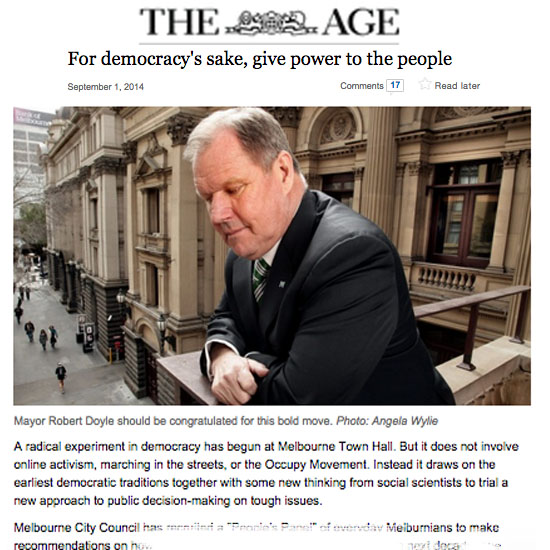
FROM THE AGE: ... with only eight out of 44 referendums succeeding in Australia since 1901, citizen juries could be used to help achieve long-overdue constitutional reform, including Indigenous recognition. In 2011, the US state of Oregon introduced citizen juries to produce reports that are distributed to all citizens ahead of voting in referendums. And in Ireland, the recent referendum on marriage equality came out of a people's assembly on constitutional reform.

Melbourne City Council is to be congratulated for opening the door to major democratic innovation in Australia. We, the people, must now push it open.
Nicholas Reece is a principal fellow at Melbourne University.

NB: It's important to note that NO LEGISLATION is required for Citizen's Juries. It only takes the will to be truly representative, more democratic and more accountable to implement an initiative such as a  CITIZEN'S JURY/PANEL!

To read this story go to 

To read this story go to 

GO TO: http://www.abc.net.au/radionational/programs/futuretense/citizens-juries-and-deliberative-democracy/5762684

What is a Citizens' Jury all about? The Citizens’ Jury has aimed to change the way democracy is done in South Australia, creating a new balance between experts and the public, and giving elected representatives confidence that public judgment (rather than opinion) can contribute to better decisions being made.
For more go to: 
South Australia's Strategic Plan, Go to:  http://saplan.org.au/pages/citizens-jury


Brief description of technique Citizens' juries have been trialed extensively in the US and Germany (where they are called planning cells), and more recently in the UK and Australia. The name 'jury' gives an idea of the process - expert witnesses are called and representative groups of citizens (usually 12-15 people) deliberate on the soundness of the arguments presented by a commissioning authority. 

To what kinds of consultation situations is this approach best suited? Citizens' juries have been used to deliberate on a range of policy and planning issues, including health, environment and social justice issues.
For more information go to: 
CITIZEN'S JURIES/PANELS: AN EVOLVING 21st C CONCEPT
Citizens’ Juries in Australia: A Discussion about Protocols (8 February 2000) 

Background: There have been a number of citizens’ juries conducted in Australia recently and it has become obvious to a small group of practitioners1 that variations have emerged: in methods of selection, in facilitation processes, in the structure of the jury and so on. Though protocols or guidelines for the operation of citizens’ juries have been developed overseas (for example by the Jefferson Center in the US and IPPR in the UK), it is clear that Australians need to develop their own. This is considered important in order to ensure that the integrity of the citizens’ jury method2 is not lost and that consistency can be assured to both organisers and participants. 

What is a citizens’ jury? A citizen’s jury is convened to carefully consider evidence and various points of view about 
For more information go to: 
http://www.activedemocracy.net/articles/protocol.pdf

Local Government and the 21st Century


The newDEMOCRCRACY Foundation says, "The Magna Carta is a touchstone for democracy: a devolution of power from an absolute Monarch to his subjects. 

The Treaty, in all its chapters, became a complementary measure to the way the King, the government of the day, governed. This year, on the 800th anniversary of that treaty, we think a further complementary measure is needed to reflect the aspirations of Australians. 

We think a complementary house of randomly selected people - A Citizens' Senate - could be trialed as a third house of parliament. We might be wrong, and that’s why we think a fair method for studying this measure, along with any others, is to put the question to a Convention, and let them spend some months deliberating on the measures. 

The Irish Constitutional Convention of 2013 is a precedent in this regard. The Irish had a mix of everyday people selected by lot (as in a jury) together with politicians - two thirds/one third. 


In Australia, we could have a similar mix to consider: ‘How can we govern ourselves better?’ and report back to Parliament. Submissions would come from all and sundry on how to improve our government. Democracy is more than ‘the vote’; it’s a way of organising ourselves, for no other reason than for ourselves."


Friday, October 2, 2015

Letter to the Editor: UTAS Inveresk Proposal

Sirs,

The public meeting called by UTAS on Friday evening in relation to the university’s aspirations to relocate to Inveresk did little more than expose a paucity of planning on the part of all the proponents.

The university blamed its declining numbers on inadequate infrastructure. However, clearly the students are not coming because the course offerings are failing to measure up to 21st Century demands.

Likewise, higher education is being exposed to culturally and socially determined demand shifts that the planning cabal is paying almost no attention to.

It was claimed that 50% of Tasmanians were “functionally illiterate” and it appeared that the ‘planners’ were counting on the other 50% looking the other way as they fumbled about.

Despite assertions to the contrary, there is an obvious lack of strategic planning and meaningful consultation backing up the current proposal to spend large amounts of public money to tweak the status quo.

On the floor of the meeting the empire builders looked quite naked under the close scrutiny of the ‘community’ whose ‘hearts and minds’ they were seeking to win over.

Time for a reality check and meaningful consultation.

Ray Norman
Trevallyn

|||| END ||||


Wednesday, September 30, 2015

UTAS PUBLIC MEETING ALBERT HALL OCT 1 5:45

Appearing on windscreen around Launceston are these flyers alerting Launceston's ratepayers & tenants to a PUBLIC MEETING called by UTAS as a part of their strategy to win HEARTS & MINDS in regard to the University's takeover of public land at Inveresk. 

The flyer poses 21 Questions to be put to the meeting.

WHERE: ALBERT HALL
WHEN: 5.45 pm  
When the least number of people can attend
Thursday OCT 1
As the flyer says BE THERE  
AND SHARE THIS POSTING 
 CLICK ON THE IMAGE TO ENLARGE

Sunday, September 27, 2015

SUBMISSION: Launceston Aquatic Centre Security Fence

TO:  Mr. R. Dobrzynski
General Manager, Launceston City Council, Town Hall, LAUNCESTON      TAS   7250 
24 September 2015

Dear Sir,

Re: DA 0331/2015 Launceston Aquatic Security Fence, 18A High St. Launceston.

We refer to the advertised application for the above. In general terms increasing security may be a valid objective – however there are a number of fundamental matters we wish to raise at the outset:
  • Why not leave the boundary fence where it is, improve the solid wall sections where presumably the unauthorized access is occurring, and save ratepayers money by not carving off any more of this heritage place unnecessarily?
  • Quality of the submission – for an application purporting to come from inside Council the quality of the submission is a sad indictment of the professionalism of council staff. If the material advertised are the only details lodged by “the applicant” – noting that the major written element is the result of a request for further information – then the application would be invalid.  In any case, given that sections A and C of the application form have not been executed, the application is invalid and should not have been advertised at all.
  • Conflict of interest? – We question the integrity of the processing and assessment of this proposal when the "owner" is cited as the General Manager, who is also applicant and to whom the public advertisement directs representors to address their submissions. Those assessing the proposal and representations received are employees of council. The issue of Launceston City Council assessing and determining its own application has been raised in the past. Other councils in Tasmania recognize the obvious bias in this situation, and refer such applications to a neighboring council to determine on their behalf.
  • Heritage – 18A High St is a Heritage Place (LCC and THC) and there should be a detailed assessment of the proposal against the relevant Historic Heritage Code and the HCH Act. Again, others should have provided such an assessment, and a suitably qualified and independent Heritage Consultant engaged. There is nothing advertised to say that the Tasmanian Heritage Council has provided an exemption from the granting of a works approval. 
It is profoundly disappointing that Launceston City Council, with all its alleged expertise and management levels finds itself with a custom-made fence that was only very recently built at no doubt considerable expense but that is allegedly not fit for purpose. This despite paying hundreds of thousanads of dollars of ratepayer funds for advisers and consultants. Launceston ratepayers should not bear the cost of incompetence either by management or its consultants.

It is self evident that a fundamental feature of the pool fence would have been to keep people from unauthorised entry. It is not as if this is a recent development that could not have been foreseen.  The phenomenon of unauthorised entry into the pool compound is not new, a midnight swim at Windmill Hill on a balmy summer night was a long-time rite of passage for countless young Launcestonians.

What attempts have been made to claim against the consultants that designed the fence? What action has been taken to ensure that management responsible for this debacle is performance managed to ensure similar things do not happen again?  Somebody has to be accountable and responsible for this.

We question the need for a new fence altogether when a few strands of the ForceField Security Fence Monitoring System installed along the top of the existing fence would most likely do the job at a much lower cost to ratepayers.

We question the need for enhanced security - if in fact there have been unauthorised entries, the application refers to a vague ‘high number’, how many have there been? What has been their pattern?  Is there a specific weak point in the fence where the majority of entries have taken place? Where is the security camera evidence and why has it not been used to prosecute intruders?

If in fact there is a security and safety issue, how does this compare with other safety risks in the municipality that are not being addressed?  Is the additional capital expenditure of $180,000 warranted for the quantum of risk being mitigated and can this cost and risk be reduced by other means, particularly in view of the chronic operating losses that Launceston Aquatic continues to incur?

What is the opportunity cost of this particular ‘safety measure’? Most people would argue that able-bodied persons capable of breaching the existing fence are the least likely to drown or be injured at the pool. As stated above, countless people have gained unauthorised access and used the former Windmill Hill pool in the past without any drownings taking place.  Similarly, many people use the First Basin pool at all hours, and for most part of the year, it has no fence around it at all, and when a fence is erected, it does not have the ultra-high security design nor electrification features proposed for this fence at Launceston Aquatic.

It is rather difficult to ascertain from the application drawing, the extent of the proposed new fence. The section towards the west extending past the Memorial Hall appears to be unchanged, and the solid wall section to the east of the outdoor pool and adjoining the changerooms, likewise appears unchanged. There is no drawing or illustration showing what the proposed fence will look like in its actual setting. The mesh panels are rectilinear and will need to have a formed, stepped base wall to counteract the sloping site, with the top being similarly stepped and hence out of character with the undulating ground and the area generally. It is of concern to note from the material presented by the applicant from the manufacturer, that this fencing system is designed for use in gaols and other like high-security compounds. It will be inconceivable that this attractive cultural heritage parkland will be given the unsavoury appearance of an encircling gaol fence. The area immediately abuts the culturally sensitive War Memorial Avenue leading to the War Memorial Hall. Images of Changi Gaol and European Concentration Camps lining this approach, are exceedingly insensitive and inappropriate.

The expansion of the fenced in area constitutes a substantial proportion of the best and most accessible parkland at Windmill Hill Park. It results in more of that space being taken away from anyone other than those paying admission fees to the Aquatic Centre. How will the additional alienation of public open space enhance Aquatic Centre revenue and by how much?  The additional open space to be added to Launceston Aquatic will need to patrolled and controlled and maintained, thus placing more demands on pool staff or more likely require more staff and costs to be borne by the ratepayers.

The application fails to demonstrate the need to create an enlarged area for facility patrons, for a large part of the year the outdoor facility is hardly used. There is no evidence of overcrowding at the facility.  The land that is regularly used by the community today will be alienated from public to be used for a limited number of days of peak pool attendance.

In 2007, Launceston City Council undertook the Launceston City Council Open Space Strategy 2007,

The strategy establishes that East Launceston already had the least area of parkland set aside, compared to all other suburbs. The Plan was to be reviewed each 5 years (a review was due in 2012), however in East Launceston there does not appear to have been any increase in the provision of open space since 2007, and to the contrary, this proposal significantly reduces what is some of the most flattish and useable parkland in Windmill Hill Park and the East Launceston suburb generally.

In the LCC Open Space Strategy 2007, Windmill Hill Park was given a score of 1/10, the highest and most valuable of all area assessments within the municipality, whereas the area that was already sectioned off into the Launceston Swimming Centre was scored at only 3/10. Ironically at an inflated figure of 39,489m”, Windmill Hill Park included the not inconsiderable park area that was technically included in the High Street road reserve, which Council ought not need to be reminded had been unceremoniously taken and paved over for the Aquatic Centre carpark! The 39,489m” of Windmill Hill Park is officially categorised by Council as a Conservation Heritage Area Park, whereas the 8,297m” area already fenced off for Launceston Aquatic is officially categorised to the lower order of Regional Sport.

Whilst, as already stated above, it is virtually impossible to read or even understand how much area of Windmill Hill Park is proposed to be fenced off by this proposal from the unreadable drawing forming the basis of this application, our professionally-calculated assessment is of the order of 1,000 m” of prime cultural heritage parkland.

The following table illustrates the deficiency suffered by the East Launceston suburb prior to this application to reduce the present parkland/open space.

Data from Launceston open Space Strategy Study


population
Park area  m2
m2/head pop
Alanvale / Newnham
5,399
220,951
41
East Launceston
2,239
64,754
29
Invermay / Inveresk
2,996
840,456
281
Kings Meadows
3,720
695,679
187
Launceston / Elphin
3,547
410,365
116
Mayfield
1,434
56,080
39
Mowbray
3,245
249,957
77
Newstead
4,366
393,306
90
Norwood
3,784
131,005
35
Punchbowl
411
256,204
623
Ravenswood
4,065
550,407
135
Rocherlea
1,143
229,141
200
South Launceston
3,739
183,174
49
St Leonard's
1,613
232,867
144
Summerhill
2,904
589,203
203
Trevallyn
4,330
1,405,734
325
Waverley
1,570
405,263
258
West Launceston
3,984
964,566
242
Youngtown
2,938
387,467
132

In summary, it is our submission that this proposal should be refused, that council's staff be directed to give consideration to making a fresh application that will be limited to proposing some relatively minor changes to raise the height of the present panels of fencing, and in doing so make considerable cost savings for ratepayers, not withstanding that the incursion into Windmill Hill Park will be avoided.


Yours faithfully,

Lionel Morrell
President
Tasmanian Ratepayers Association Inc.


Sunday, September 6, 2015

Upset artist sees artworks withdrawn


THREE ceramic works have been withdrawn at the artist's request from the Growth Change Influence: the University of Tasmania 125-year anniversary exhibition, which is on show at Launceston's Queen Victoria Museum and Art Gallery, Royal Park. 
The works by Michael Murrell were removed from display on Monday. 

Murrell's request was the result of frustration and disappointment at having not received an invitation to attend the official opening of the exhibition on August 1. 

Murrell personally approached Launceston mayor Albert van Zetten about what from his viewpoint was a major oversight given the long connection he had had with each of the institutions involved. 

He has also been in communication with QVMAG director Richard Mulvaney and the university's gallery curator Malcom Bywaters. 

Each of these people have conveyed by letter that it was "an honest mistake" that Murrell's name did not appear on the guest list. 

Murrell's frustration comes from what he maintains is a general shifting of blame. 

 "Someone needs to take responsibility for this, instead of shifting the blame, because there's at least four invitation lists connected to this exhibition that should have and could have included me," he said. 

Mr Mulvaney said the request to remove Murrell's work had been regrettable. 

"It is always regrettable when works are withdrawn from an exhibition."  

"This exhibition covers an important history of art in Tasmania that spans 125 years, that makes it particularly significant, and while it cannot cover everyone who has contributed, those who have works on show were chosen for pertinent reasons." 

Previously Mr Murrell has donated works, his own as well as pieces by other significant Tasmanian artists including Bea Maddock and Les Blakeborough, to the permanent collection of the QVMAG.

Growth Change Influence continues at the QVMAG until November. Entry is free.


FROM FACEbook ...  Its time that PUBLIC institutions got their act together! It is no longer the case that 'artists' have to take what's dealt out to them by them. Like, having their work used without reference to their MORAL RIGHTS, like expecting them to "donate" their work, skills and knowledge on the strength that "it good for their reputation". Accountability is very often a foreign concept!

Social Media will increasingly hold these institutions to ACCOUNT and for many its not before time.
ARTISTS CAN STRIKE BACK
SEE FACEbook

HOBART'S GM OUTAGED


FROM FACEBOOK

HEATH SEEKS COMPENSATION OVER ALDERMANIC & STAFF DINNER

Hobart City Council General Manager Nick Heath is reportedly furious over suggestion that the lavish fortnightly banquet enjoyed by Aldermen and senior staff should be cut back.

An inside source reports that Heath learned of the proposal at last weeks dinner when it was first put forward by Alderman Peter Sexton.

“He was furious, he nearly choked on his crayfish,” said one onlooker “He started throwing salmon and spilling champagne, he had food all over his chin, people were slipping over on caviar. It was like watching Jabba the Hutt turn into the Hulk or something”.

In a statement, Heath’s lawyer has confirmed he will be seeking a 20% increase to his $350,000 salary as compensation. “A man has to eat” said his lawyer, “It’s only fair that they get to dine in a style they are accustomed to, I mean all these cutbacks and transparency, I am telling you my client won’t stand for it. Christ, next they will have to travel economy and not be allowed to import office furniture. Anyway doesn’t everyone get free catered lunches at work? Why should they be treated differently?”

The proposal may still not get through as with all council tenders, staffing, grants and support for projects, the final decision is put before Heath for his personal consideration.

Thursday, August 13, 2015

LCC & Community Standards

Dear Mayor and Aldermen,

Under the circumstances I imagine that Council’s instincts – management’s in particular – will be to shut down any correspondence to do with the publicised sacking of a council employee of 62 years standing. Likewise I expect that you’ll be predisposed to tell me:
 
  1. That its inappropriate to discuss individual operational matters;
  2. That safety directives and conventions must be complied with by all employees irrespective of their status;
  3. That the sacking of an employee only follows a process of performance reviews relative to KPIs, etc;  
  4. That such matters are the province of ‘the unions’ and ‘management’ and thus not an Aldermanic matter;
  5. That the employee of 62 years standing  was dismissed because of safety breaches; and of course
  6. That LCC is an employer regarded as one upholding the highest stands.

If you are to tell me these things the evidence upon which you might make such assertions falls short of “community expectations”, that is the community that elects and employs you to represent it, and to whom you are accountable.

Moreover council’s action, in regard to potential psychological stress and trauma – plus the consequences of these issues –  in this case, as likely as not, could well be found to be unsafe, thus exposing you as aldermen; council employees; and ratepayers alike; to a set of predictable and unacceptable risks.

I look forward to your response to the issues I raise here with considerable interest and specifically so in respect to LCC’s Organisational Values and community standards, not to mention Sections 62 & 65 of the Local Govt. Act.

Regards,

Ray Norman

Ray Norman
<zingHOUSEunlimited>
The lifestyle design enterprise and research network

PH: 03-6334 2176
EMAIL 1: raynorman@eftel.net.au
EMAIL 2: ray@7250.net
40 Delamere Crescent Trevallyn TAS. 7250
WEBsite: http://www.raynorman7250.blogspot.com

CLICK HERE:
http://www.launceston.tas.gov.au/lcc/index.php?c=69

“A body of men holding themselves accountable to nobody ought not to be trusted by anybody.” — Thomas Paine


Sacked after 62 years
By JAMES BRADY Aug. 10, 2015, 11:19 p.m.
http://www.examiner.com.au/story/3270626/sacked-after-62-years/

THE Launceston City Council has defended its position in sacking an employee with 62 years of service amid heat from the Australian Services Union.

The union claims that the decision to fire rural roads co-ordinator David Flynn for breaching safety protocols was made in a bid to avoid paying a full redundancy.

ASU Victoria-Tasmania organiser Kath Ryman said the union was calling on the council to reinstate Mr Flynn before undertaking a ‘‘fair investigation into safety procedures at council’’.

‘‘The problem is that council have failed to genuinely investigate and consider evidence that was provided by the ASU to show that the same practices that constituted David’s alleged safety breaches are commonly used practices across the organisation,’’ Ms Ryman said.

 ‘‘Despite some denial from council, we believe that a review of the rural roads crew recommended that David’s position as rural roads co-ordinator position be made redundant.’’

Launceston general manager Robert Dobryznski said he was unable to provide details of Mr Flynn’s termination, but that the council held a legal responsibility to ensure safe work practices.

‘‘The council also has a legal obligation to take decisive action – however difficult it may be in the circumstances – to address repeated instances of unsafe work practices, particularly when numerous attempts have been made to provide support and training,’’ Mr Dobryznski said.

‘‘While dismissal is extremely disappointing and a last resort, the potential for injury or loss of life of employees makes it imperative that safety standards are enforced.

‘‘In cases where we are forced to take this course of action, we follow a robust and procedurally fair process and the employee is provided with reasons behind the decision that has led to termina
tion.’’

Ms Ryman said the decision was made on the back of a restructure of the council’s infrastr
ucture services directorate, and that four redundancies were offered to employees in the Parks Services area.

‘‘These workers were given the option to apply for new, very similar positions, but the application process for these new positions required an unnecessary medical assessment to be undertaken,’’ she said.

‘‘Some of these workers had previous workplace injuries sustained during their years of dedicated service to council, so they reluctantly chose to take the redundancy, fearing council would discriminate and use the results of the medical assessment against them.’’

.