Council in Tasmania are striking their 2010-2011 rates and for some ratepayers it is not a happy time. In
Launceston the rate rise is
on average 5.5%. So long as rates continue to rise incrementally the ability of a great many ratepayers decreases incrementally.
Launceston's ratepayers have been advocating a change to the method of striking the rates but they have had no joy at all to date.
By and large their Aldermen have let them down and it seems that the tail is still wagging the dog at Town Hall in
Launceston. Council officers seem to be delivering Alderman with an ultimatum that is otherwise called a budget. It seems that they
(the officers) decide upon the method that suits their purposes best. Yes, that's the one that maintains status
quo staffing levels, determines salary levels and delivers bonuses plus benefits the higher up the pecking order you go. In short it seems that their is no incentive whatsoever for Council officers to lower the rate base.
Then we come to Aldermen and Councilors. Again it seems that they are presented with budget that is in fact a
'fete de compli'. It also seems they do not have the appetite to take their officers on in the cause of delivering a more equitable system. Some officers even go so far as to suggest that
"rates are a kind of wealth tax." From the luxurious position of being relatively highly paid and being appointed rather than elected that's a bit rich
– and somewhat inappropriate as well.
The question about
the legality of the models used by
Devonport, Georgetown, Brighton Councils has been around for quite some time
– there has been plenty of time to fix the legislation, and that can still be done if Councils lobbied for it. Of course, the opinions about the
legality of these flat rating or capped rating municipalities are nothing more than that,
opinions. The so called
"delinquent councils" have been told that they are out of order –
but they continue nonetheless. So why can’t other councils join them ?
Launceston even?Focusing on
Launceston again,
Rob Soward, paraphrased, promised to fix the system. He may have been a little naive in imagining that he could effect change all by himself , but there you go. He could only count on one vote in twelve
– but after all it was election time. Interestingly only one Alderman on
LCC voted against the 5.5% rate rise,
Ald. Ball, and
Ald.
Soward was missing in action –
he voted for the rise. Nonetheless
Ald Soward has said that he had :
- "a detailed and extensive briefing (on two seperate occasions) around a number of rating models and what they can offer for Launceston (benefits/ negatives etc) . I am in favour of the so called Devonport model where rates are capped ... It is a model that would lead to very very slight increases in some rating areas (low SES areas like Waverley, Ravenswood etc) and huge reductions in prime residential areas. There would be some increases in business property rates but these would be far less than the reduction in prime residential rates- the only people who would be worse off in my view under the new "Devonport"model would be a Waverley ratepayer and resident who owned a large factory in Launceston (and I don’t think there would be too many of those) The areas that would see an increase would see an increase of around 2 percent- under CPI."
Well,
Launceston's ratepayers are not happy, and have not been since the massive increases were implemented. There are over 8,000
(out of 27,000) ratepayers affected by unfairly high rates . Many ratepayer’s found their rates reduced, static or not rising in accordance with CPI during this period. However,
Launcestonians pay higher rates than residential ratepayers in many interstate suburbs whose property values are several times more valuable than they are in
Launceston.
Clearly, there is an equity issue to be answered here not to mention the fact that other budget restraints are necessary. Over the same period, council’s budget increased by
$30 million. Who benefits form this? It certainly isn't the ratepayers. This an issue that is not going to go away and it is one where Aldermen/Councillors and Council officer alike will be called upon to engage with their constituencies
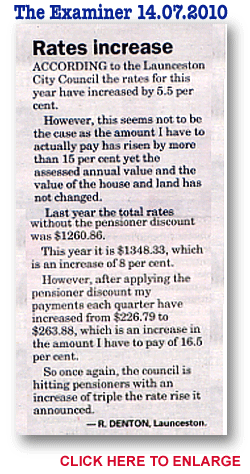
CLICK ON THE IMAGE TO ENLARGE  Comments and opinions are welcomed. Please use the comment section below.


 The General Manager's initiative to consult with Launceston's ratepayers in regard to the striking of the annual rate before it was actually struck was unwelcomed by three Aldermen but wholeheartedly endorsed by the city's Ratepayer's Association. Does that tell you anything?