Thursday, July 14, 2011

THE MERCUY: Push to shrink council


CHARLES WATERHOUSE | July 13, 2011 12.01am
A GLENORCHY alderman wants his council to follow Kingborough Council's lead in seeking to cut its number of elected members from 12 to 10.

Alderman Matt Stevenson hopes Glenorchy City Council will support a motion from him requesting the Local Government Board to review the number of aldermen on the council with the council's preferred number a cut from 12 to 10.

Ald Stevenson said cost savings should not be the main reason to do such a review but the catalyst was the state's water and sewerage reforms, which had effectively reduced the role and responsibilities of the council.

Water and sewerage, formerly under the control of councils statewide, is now managed by three water corporations set up by the State Government.

He said the cost of supporting Glenorchy aldermen in 2009-10 was $389,992 and the cost of a single alderman was $23,489.

Cost savings could be directed to reduce rates. "I think we are spending a bit too much on aldermanic payments when we could probably represent Glenorchy with fewer aldermen for the same outcome," Ald Stevenson said.

In percentage terms Glenorchy City Council's rate rise for the new financial year (7.5 per cent) was the highest in greater Hobart, along with Hobart City Council, which imposed a similar rise.

Ald Stevenson said his preference was to cut two aldermen at the Tasmanian local government elections in October but any change would have to be determined by the Local Government Board.

His motion will be discussed at a meeting later this month.

CONTACT CHARLES WATERHOUSE ... waterhousec@news.net.au

EDITOR"S NOTE: If Aldermen who hold more than position that draws on the public purse were excluded, that would be somewhere to start in some Councils.

Have your say in the comments section below

PIGS MIGHT FLY: Affordable Housing Approved in Tasmania

Affordable Housing – Living Cooperatively Nubeena, Tasmania
July 13th, 2011

Lynne Seddon from the Tasman Village project has contacted us about their ‘affordable’ community village project at Nubeena on Tassie’s south-east coast.

The Mercury reports that plans for a 65 lot community village on nine hectares at Nubeena have been approved by the Tasman Council and that this new village will surround the existing Parsons Bay Retreat.

A Village For a Range Of People And Activities
Developer Ilan Arnon says the Tasman Village project will offer affordable housing for retirees, young families and sea-changers and he expects the development to appeal to a wide range of people, including those looking for a holiday property.

The land is strata titled so people will be able to sell whenever they wish.

The blocks are small but every participant shares the open space, parklands, recreation and food-production spaces.

Ilan’s development in Nubeena is being created on 24 acres of disused golf course surrounding a 19 unit holiday complex. The Parsons Bay Retreat, built in the 1970s, will be rejuvenated and used as a base that will include tennis courts, a swimming pool, a licensed cafe, therapy rooms and areas for arts and events.

This Tasman Village development had been his life-long dream, inspired by years spent in a kibbutz in Israel as a teenager.

What Ilan Says About His Project
People of all ages from interstate and overseas are being attracted to the development which is still in its still in its early stages.

“I believe this is an idea whose time has come..

A kibbutz is a collective community in a rural environment where people choose to work cooperatively with shared resources aiming to be self sufficient. In these very uncertain times we need to look at becoming more self sufficient and not be dependent on complicated infrastructure ... Click here to read the full story on "PIGS WILL FLY"

EDITORS NOTE: Now this is a bit of a pace setter for other Tasmanian Local Government even if they no longer able to claim to be leading the pace. That aside, this concept is worth championing as a 21st Century idea.

Wednesday, July 13, 2011

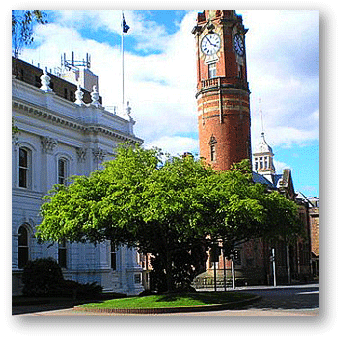
LAUNCESTON'S GREAT CLOCK DEBATE

CLICK ON THE IMAGE TO ENLARGE
The Mayor's stance on this issue is both interesting and reassuring. He has actually done some evidence gathering that turns out to be quite compelling.

In contrast Ald. Dean seems to be presenting circumstantial evidence and he, as an ex-policeman, should (might?) have looked a little harder for evidence with more substance and credibility before he sparked this debate.

We can only draw our own conclusions about all of this and other issues in respect to the quality of Ald. Dean's evidence when it is presented.

Importantly, keep on looking for the credibility gaps, they may well present themselves.

POST OFFICE CLOCK: Full Letter to The Editor

Dear Editor,

I see that Ivan Dean is lobbying again on behalf of the city's hoteliers to have the Post Office clock stopped, using the excuse that it hurts tourism in the city.

Last week I read a letter in these pages from Ivan in which he claimed he was only calling for a report to be written about the clock. But the Examiner article today makes his position clear. On ABC TV last night I even heard Ivan speaking on behalf of the Quest calling for the clock bell to be buried in the Tamar silt.

My wife and I live two doors down from the clock. We love it. It's part of Launceston's rich tapestry of cultural and historic heritage. It's part of what makes this city unique and special. Even though we're the clock's - and the City Council's - nearest residential neighbours, we don't think that Ivan or his report writers will ask us what we think about the clock. They certainly haven't done so yet. So I'd like to offer a few constructive suggestions.

Number One: Launceston does have a noise problem at night, particularly on Friday and Saturday nights, caused by the hoteliers who pump out a thumping raucous cacophony that passes for music, until at least 2am and at decibel levels well beyond Council's own regulations. From 2am to 4am the city is then beset by drunken, noisy yahoos staggering home from the hotels - effing and blinding at the top of their voices every inch of the way. Want a cause to fight, Ivan? Fix that!

Number Two: the clock had been striking the hour for a hundred years before the Quest opened its doors. Even the slightest investigation would have told the developer that. If the clock is too loud now, fix the problem yourself, Quest! While I read today in the Examiner that the Quest has belatedly double-glazed some windows , it clearly needs to do a proper job. The Quest shouldn't expect the city to become dull, bland and ordinary just to suit them.

Number Three: bring some facts to the table for Council to consider. Put sound recording and measuring equipment in any room of the Quest's choosing on any Friday or Saturday night between midnight and 2am and record the noise. Play the recording and present the data at a Council meeting. If the Aldermen can hear the clock above the hoteliers' raucous din, I'll run naked down Brisbane Street!

Number Four: Ivan Dean, you are the Chairman of Launceston City Council's Heritage Committee. Rather than it being just another of your well-paid sinecures, how about speaking out for the city's heritage? Even better, help the city (and its hoteliers) by using your influence to get the Council to do something - anything - to promote Launceston to mainland tourists. Better still, use what precious little influence you have within State parliament to get Tourism Tasmania to promote the state to the mainland tourist market. But even if you can't do that, spare us all and hush up about the clock.

Trevor Jones
--
1842 Fine Handcrafted Furniture and Art, 121 Cimitiere Street, Launceston, Tasmania 7250

EDITORS NOTE: Simply because we are not limited by space, and the fact that we are committed to publishing without fear or favour, we publish letter such as this one unedited for the record. We think that is worthwhile.

Tuesday, July 12, 2011

THE CLOCK DIVERSIONARY TACTIC

As a political tactician Ald Dean is about as streetwise as a fox. You know the animal, the one Ald Dean does not believe has taken up residence anywhere in Tasmania. Now he has a new diversionary tactic in his box of political tricks. His current target is Launceston's 'heritage' Post Office Clock.

Looking at today's press this attention grabber seems to bepaying him the kind of dividend he is looking for even if the whole affair appears to be a tad silly.

Yesterday's Council meeting was interesting in couple of ways. As unlikely as it may be Ald. Dean chairs the Council's Heritage Committee. It is hard to imagine how he can reconcile that role with his stance on the PO clock but that's the way it is in Dean's World.

Interestingly, at yesterday's meeting the Aldermen endorsed a plan to put up signage at the city's entry points welcoming visitors to Launceston the "heritage city." For some reason Ald. Dean, nor it seems other Aldermen either, just did not see the irony in Ald. Dean's championing the the silencing of the PO clock and his position on the Heritage Committee.

However, where Ald. Dean's 'clock stance' gets more interesting is yesterday's Council meeting's main item of business, the setting of the city's 2011-2012 budget and rates. Ald. Dean's past assertions that the 'Brighton Rates Model' is flawed, inappropriate, in contravention of the Local Govt. Act, wrong in some way, are now being tested.

It seems he has never been an advocate of such a test and you would have to wonder why not when the Brighton Model, from all accounts, delivers fairness and equity to ratepayers. So, if the city's PO clock provided a diversion from Ald Dean's flagging credibility in regard to the city's budget you have think it has chimed in like a charm and just in time.

It is also interesting to note that as a part of the city's budget something in the order of $6 million was allocated to extending the city's landfill capacity at its 'Waste Centre.' The irony in the timing of this also seems to have been lost in wake of the Federal Govt's Carbon Tax cum ETS announcement on Sunday. One suspects that there is more to be said on that subject that may eclipse the PO clock chimes as a topic worthy of aldermanic attention. Then again maybe not!

Monday, July 11, 2011

A PLEA TO KEEP THE CHIMES RINGING

Dear Mayor Van Zetton and All Aldermen of LCC,

The sound of the clock has been the source of many recent phone calls to the Launceston Historical Society since it has attracted media attention and now LCC business.

The LHS would like to register our support for the sound and indeed the historical essence of Launceston to remain in tact and continue.

Members, associates, and indeed travellers at the recent AHA national conference, all commented what a delight it is to hear such a unique sound continue in such a historic regional centre.

The Launceston Post Office is one of the jewels in the crown of Launceston's heritage and indeed it was a sad day when the main Post Office closed after such a long and historical use. For the clock to be silenced or the chimes to be excluded during the night would be to the detriment of a long tradition and indeed landmark sound of Launceston.

Yours Sincerely

Dr Marita Bardenhagen,

President, Launceston Historical Society Inc.,
P O Box 1296,
Launceston TAS 7250.

Saturday, July 9, 2011

LAUNCESTON POST OFFICE CLOCK: To silence it or not

HERITAGE PROTECTION SOCIETY (TASMANIA) INC.
P.O. Box 513 Launceston Tasmania 7250
9 July 2011

TO: The Mayor,
Alderman Albert van Zettan
Launceston City Council
Town Hall
St John Street
LAUNCESTON TAS 7250

Dear Mr Mayor,

We write once more regarding the Launceston Centenary Clock in the Launceston Post Office Tower.

We note for the third time, the reference in Council's Agenda by Alderman Ivan Dean for an enquiry into calls for the striking of the time to be ceased during the night. As a community-based organisation established to recognise
and protect our cultural heritage, we very strongly argue for the continuation of the present arrangements.

We are confident that Launceston citizens do not want the clock silenced at night, and accordingly ask that at its meeting Council not waste resources progressing this matter.

Town clocks with chimes are a common feature in most historic, but also in modern, cities, towns and communities across the world. These clocks are abmajor heritage attraction, and source of great pride in their communities, as it is here in Launceston, Australia's third oldest city.

In middle eastern countries, for instance, the ringing out and calling out from prayer centres is another commonly accepted practice. It would be unheard of for such practices to be silenced.

We find it disappointing that Ald. Dean, being also Chairman of LCC's Heritage Advisory Committee, has not sought an opinion on the night-time silencing of the clock, from that committee prior to again bringing the issue before Council. This may have been because from our enquiry of committee membership, we believe that such support would not be forthcoming.

In relation to an associated issue, on 4th August 2010 we drew Council's attention to the words of the prayer that relate to the musical chimes in Launceston. These words are recorded in a framed document within the Post Office Tower, at the level of the mechanism. We suggested that the words be Launceston Centenary Clock placed in a suitable display case at the public level of the Post Office, along with other information of an historical nature concerning the clock.

We offered to assist with this task, and also said we would be prepared to raise some funds towards the cost. We are disappointed that there has not been any progress to advance this concept.

We look forward to gaining Council's support.

Yours faithfully,

Lionel J. Morrell
President

PLEASE CLICK ON AN IMAGE TO ENLARGE

A UK PRECEDENT: Anger as single complaint silences Burntisland clock A ding-dong has developed after a historic town clock was silenced following a single complaint about noise.

Some 300 Burntisland residents have signed a petition to have the chimes of the High Street clock reinstated after they were switched off following the objection.

The clock, part of the Burgh Chambers and thought to have been keeping time in the town for over a century, was silenced by Fife Council after the complaint stated the noise was keeping a resident awake ... Click here to read this story online

ANOTHER UK PRECEDENT: People call for return of chimes
Calls by a rector to restore the traditional chimes of a historic church clock have been given a huge vote of support by local people.

The Rector of Wallingford, the Rev John Morley, has attacked Wallingford Town Council for continuing to silence the recently restored town clock.

A voteline set up by the Oxford Mail's sister paper, The Wallingford Herald, set up to find out the views of our readers, revealed 90 per cent thought the clock's traditional chimes should be reinstated.

The result makes a mockery of claims by town councillors that the bells would be an unwelcome nuisance, and Mr Morley urged members to back down and let the bells be heard ... Click here to read this story online

SEE COMMENTS
THE LINK

Friday, July 8, 2011

The Sustainability Idea: Another way to think about going to the toilet

This man, Swedish architect and designer Anders Nyquist, might talk a lot about 'pee and poo' but what he has to say is far from being a load of crap.

His TEDxTalk is something of a revelation even if for those who have been thinking about new ways to doing things 'sustainably' for yonks actually now his story quite well.

Albeit that what he has to say is likely to be summarily dismissed by many Tasmanian Local Govt. functionaries it is just the kind of thing they should be listening to.

More than that, if they want to be part of the solution, rather than part of the problem, we need them to be across what this man has to say. Some are, but all too few.

THE RATE DEBATE IN LAUNCESTON WARMS UP

Even if Launceston's Aldermen comply with Council management's world view this year, and yet again, the 'RATE DEBATE" is not likely too go away in an election year. There are quite a few long standing Aldermen who are up for election this year if they stand again.

Ald Dean for instance is now saying he has "never asserted that the Brighton Model was in contravention of the law" but many ratepayers have different memories. Also, Mr Dobrzynski has canvassed the idea that the so called Brighton Model is in contravention of the law – or words to that effect, and in public if not on the record. Clearly, many ratepayers have defective memories, or short memories, but do they?

If ratepayers think that a flat rate – one that's fair and equitable, one that covers the costs of all services including those some Aldermen and the GM say are regional services unfunded regionally – should have been implemented a long time ago, well are they misguided? If a flat rate had been implemented it is more than likely that there would have been the incentive to mitigate against waste because that kind of mechanism would quite likely expose all kinds of wasteful activities and expenditure, or is that flawed thinking? If so please show us, the ratepayers, compelling evidence for everything staying the same.
Petar Hill

Thursday, July 7, 2011

Letter to the Attorney General

Tasmanian Ratepayers’ Association Inc.
P.O. Box 2039,
NEWNHAM TAS 7248
7 July 2011,

Hon. Brian Wightman MP
Attorney General Tasmania
Parliament House
HOBART TAS 7000
email to Brian.Wightman@dpac.tas.gov.au


Dear Mr. Wightman,

Re: Brighton Council Rating Resolution.

Our Association takes an active interest in Local Government rating methods, and in the past has made submissions to the Tasmanian Government in relation to the matter.

We note that on 21st June 2011, Brighton Council passed a resolution levying rates and charges for Brighton Municipality as set down in the attached document.

We understand from information received from Brighton Council that Brighton Council devises what it terms “Brighton fairer rating model”. They say they have widely consulted their community and undertaken an extensive survey which shows overwhelming support for their rating method within their community. Apparently, George Town Council and Glamorgan Spring Bay Council have also now adopted a similar flat rating model for residential properties and other councils are now progressing towards a flatter structure. They believe their model to be a fairer and more transparent method as well as totally eliminating the rating volatility that occurs with property based residential rating following revaluation.

This is the 5th year that Brighton has adopted the fairer rating model. They believe they are on sound legal footing and are encouraged by supporting legal advice, but accept that there is varying legal opinion to rating methodology across Tasmania (not just theirs) due to the complexity of the Local Government Act.

None-the-less, Brighton Council is clearly being allowed to strike rates in their municipality on this basis, with complete knowledge and disclosure to government.

We are therefore seeking to learn from you whether this is the case and whether the rating method utilised by Brighton Council complies with their lawful duties pursuant to the Local Government Act (1973).

We are inclined towards the fairer method successfully levied by Brighton Council and want to encourage other Municipalities to follow suit. Likewise, we are encouraged by comments from the government during a recent debate on rating legislation in the upper house where we understand the government now supports the outcome of Brighton rating policies for the Tasmanian community.

We look forward to receiving your response in a timely manner.


Yours faithfully,

Lionel J. Morrell
President
Tasmanian Ratepayers Association Inc.

Wednesday, July 6, 2011

A Letter to Tasmanian Ratepayers from Brighton Council

Dear Lionel,

Subject: RE: Important request concerning Brighton Rating Method

I hope you accept my response instead of Ron Sanderson due the urgency of your requested reply. Ron is caught up in meetings and unavailable for comment in the short term.

Brighton Council is encouraged by your support of the “Brighton fairer rating model”. We have widely consulted our community and undertaken an extensive survey which shows overwhelming support for our rating method within our community. George Town Council and Glamorgan Spring bay have also now adopted a similar flat rating model for residential properties and other councils are now progressing towards a flatter structure. We believe our model to be a fairer and more transparent method as well as totally eliminating the rating volatility that occurs with property based residential rating following revaluation. However, only the residents of Launceston know what is best for them and we would support whatever method they wish to adopt.

This is our 5th year that Brighton has adopted the fairer rating model. We believe we are on sound legal footing and are encouraged by supporting legal advice. I am sorry that we are not able to distribute specific legal advice due to confidentiality issues. We accept that there is varying legal opinion to rating methodology across Tasmania (not just ours) due to the complexity of the Local Government Act. Perhaps Launceston City Council should seek alternate legal advice.

Brighton Council is also encouraged by comments from the government during a recent debate on rating legislation in the upper house where the government now supports the outcome of Brighton rating policies for their community and wants to make sure it is placed on a firm legislative foundation. This has been promised before the end of the calendar year. It is fortuitous for Launceston City Council to have two aldermen in the legislative council.

If Alderman have any doubt as to the legislative certainty of the “Brighton Fairer Rating Model” then they are in a position to introduce or support change that will provide that legal certainty.

Regards

GREGORY DAVOREN BCom
DEPUTY GENERAL MANAGER
1 Tivoli Road, Gagebrook TAS 7030
www.brighton.tas.gov.au

Tuesday, July 5, 2011

A COMPARISON BETWEEN LAUNCESTON & BRIGHTON?


Comment Posted by Brighton Council ... click here to see it
Brighton Council has kept rates at CPI for 15 years in a row. Brighton Council provides a flat rate for all residential properties although the rate is discounted to 3 suburbs that are predominately Housing dept areas. The maximum any residential property pays for its general rate is $780.00 ... The total rate paid in each commercial sector is also linked to CPI.

On 4/07/11 5:23 PM, "Ivan Dean" wrote:

To: Launceston Ratepayer who drew Launceston Aldermen's attention to Brighton Council's comment

Brighton is a very small council with nowhere near the infrastructure we have and from memory they have no regional facilities and there are many other differences.

If you are going to compare councils you need to do so on an apples with apples basis and not water melons and grapes basis. There is also some evidence to show that what Brighton has done is not in compliance with the local govt Act.
Ivan Dean

The Launceston Ratepayer's reply to Ald. Dean,

Dear Ald. Dean,
Thank you for your eMail. Might I point out that I’ve not made a comparison between Launceston and Brighton. However it seems that you are doing so. I am simply a subscriber to the Tasmanian Ratepayer’s website and I found it somewhat interesting that the “Brighton Council” posted the comment on the site. Just who at Brighton Council I have no idea but it is of interest, some interest to me, that this council should make the comment that it did and that it was moved to do so for whatever reason.

In the light of all that I thought that it was worth drawing this to Aldermen’s attention. Make of it what you will but as time progresses I suspect Brighton’s stance may well gain some perspective. I am sure that in the end justice will prevail if the council is in contravention of the Act.

Regards,
Ratepayer R ( Name withheld for privacy reasons)

THE EDITOR SAYS: In its own way this thread of correspondence tells a tale.

Saturday, July 2, 2011

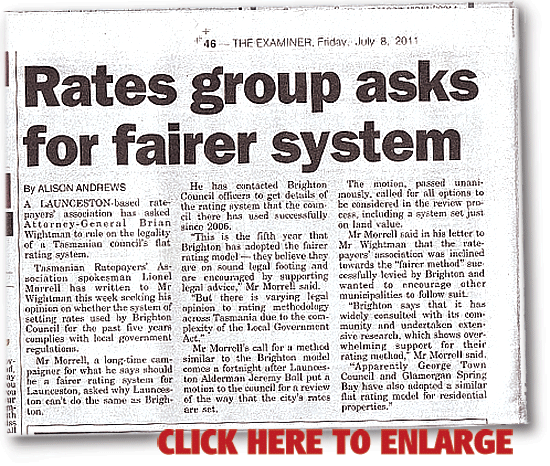
THE RATES DEBATE – Launceston City Council

PLEASE CLICK ON THE IMAGE TO ENLARGE
PLEASE CLICK HERE TO READ THE STORY ONLINE

There is likely to be a debate about what is an equitable or reasonable rate to pay to provide the services a city's citizens depend upon. There is quite a bit of subjectivity in the idea equability but it is something every ratepayer is looking for.

Mayor van Zetten says in the Examiner today that "the rating system deemed to be the most equitable will be implemented for the 2012-13 financial year." Is he saying that the present system, and the proposed rates for 2011-12 are inequitable? You would be forgiven for thinking so.

The Examiner reports that the Aldermen have been told that Ald. Ball's ambition to implement changes to rates for the 2011-12 budget "was impossible," presumably by GM Dobrzynski. By what criteria? It may take some time and effort but an inequitable rating system should not be tolerated by Aldermen, the ratepayers' representatives.

Mr. Dobrzynski, in a communication to the TRA, has said that the "comparisons with Boorandara City Council [and LCC] reflect a fundamental misunderstanding on the way the rating system works." If you were to be paying rates in both jurisdictions there would certainly be a lack of understanding in regard to the differences between your two rate bills. It is open to conjecture as whether or not it would be a "fundamental misunderstanding of the rating system" or not.

It seems that Launceston City Council deems that rate equity is a matter of discretion rather than anything to do with the quality of being fair and impartial: equity of treatment. Its seems that it has been deemed that Launceston's ratepayers can wait for it, however long that may take.
Petar Hill

Friday, July 1, 2011

RATE ACCOUNTABILITY

Launceston's GM, Robert Dobrzynski, entertains the idea that he has an opinion that counts when it comes to policy determination. He espouses rates being a "wealth tax" and a "progressive" one at that.

He is allowed an opinion but it shouldn't count for all that much because his role is to do the enacting of policies determined by the Aldermen. And when there is a legal impediment bound up in his opinion it should count for nothing. He is by his own words, he is "accountable to the Aldermen" and this carries the unspoken subtext "not the ratepayers." He is unelected servant of the city.

However he is never backward in coming forward when he believes that Aldermen stray into "operational matters". Typically he'll lecture them loud and long if they stray, but who is lecturing him, or even telling him, about the inappropriateness of his espousing and advocating opinions and especially so when he is on shaky ground. It is not his role and he'll tell you so when its convenient so to do.

Note his response to a request for information ... "It is entirely inappropriate for Council Officers to respond to you on the matters raised in your submission prior to the Council's consideration of the submissions. It is the elected Council that determines a position on the submissions received, not the Council officers. As with other matters, the role of the administration is to provide sufficient information and recommendations on the matters raised to enable consideration by the Aldermen and a decision by the Council." He is right of course but he expects the Aldermen to accept his opinion as being "sufficient" to meet his assessment the operational demands determined by him and his underlings for their purposes.

Mr. Dobrzynski is, it would appear, disinclined to search for savings evidenced by expenditures all too often exceeding the CPI. As requests for information are rebuffed it seems that they are "entirely inappropriate" no matter who asks. One day this may change but do not hold your breath this year.

Thursday, June 30, 2011

An interesting Ratepayers Response to The Association's Submission to LCC

A Background Note: Launceston has a ratepayer who pays rates in various constituencies and is therefore qualified to make comparisons between LCC's performance and rating priorities and their experiences with other councils elsewhere in Australia and the UK.

To quote "Greetings from England, and CONGRATULATIONS! A most commendable submission, and we most fervently trust there is a substantial and meaningful response.

As a matter of interest, in the county of
Wiltshire, re-cycling is a big issue: it is let to a private contractor for sale/disposal; many 'free' household re-cycle centres have been set up on the outskirts of towns, in which every conceivable type of waste is collected and sorted; from electronic, green garden, household etc. etc.. ratepayers are most supportive, and a visit to such places has become almost a social event!

However the general drift of your submission is worthy of adaption to a world wide context; I'll not launch into similar situations that could be observed here! Local rates are being kept exactly the same level as last year, in response to central government demands for economies.


Cheers, Susan and Mike "


Launceston ratepayers can only dream of anything like the experiences of their UK sisters and brothers being theirs too!

LCC's New Consultation Policy Looks More and More Cynical

In the end this idea that the ratepayers should be consulted about their rates now has all the signs of being a relatively cynical exercise. If you have any experience in bureaucracy at all you know that you NEVER go into a meeting unless you already know what the outcome will be. We should have seen this one coming.

Launceston City Council's GM, Robert Dobrzynski, advocated the process and he received some aldermanic resistance ... surprise surprise. There are a number of Aldermen that harbour the idea that ratepayers gave up all interest in the management of council and the city when the polls were declared. Has anyone met a ratepayer like that?

On the face of it Mr. Dobrzynski needed to be congratulated for his stance that gave ratepayers a louder voice and the association did congratulate him. BUT it is a different story once the submission process is over. It is unclear what is being done with or about the submissions that came from the process. Filtered one suspects. This is an unfolding story and it looks like the picture is less and less pretty as time passes .

Interestingly Ald. Ball was a strong advocate for the process and true to form he delivered some impassioned rhetoric on the subject. There were two meetings and both were poorly attended. Curiously, Ald. Ball was not at either of the meetings he was such a passionate advocate for and neither was he an apology for either of them. The title "Alderman Bandwagon" does seem to have something to it and increasingly so.

Ald. Ball as an alderman has complex views on many things and he is a vociferous advocate too. At the last council meeting there was yet another example of his complexity in action. The matter under consideration was the removal of a dangerous tree but it seems that Ald. Ball was sticking up for its retention. Anyone who read the article in The Examiner could see that this tree needed to be removed but there was a bandwagon to jump on here and it seems Ald. Ball just couldn't resist .... click here to read the story

To return to the rates issue in Launceston, it is going to be interesting to see who jumps where but one suspects all the jumping will be done as they say "in camera." Its odds on that nothing much will change from the original proposition. The same old, same old reigns supreme, so watch this space! It would be very nice to be wrong for a change!

COUNCIL PERFORMANCE INDICATORS

Well it has to be said that Frank Dean hits the nail on the head. North Midlands' Councilors have behaved better than many other Council and demonstrated some constraint. What is often noticeable for Council budgets in general terms is that they typically increase at a rate in excess of the CPI.

If you ask an officer why this is so and you'll get a load of blah blah blah blah AND your bull dust alarm will ring very early in the conversation. Ask an Alderman/Councilor and you'll typically get officer generated bureau babble spouted at you and something along the lines that it is hard to blah blah blah blah AND your bull dust alarm will ring very loudly again.

What we all need to understand is that largely council officers are:
  • very good at spending ratepayers' money;
  • often not all that good at accountability
  • good at ensuring that their salaries and superannuation continually rise without too much performance assessment interfering; and
  • not at all good at devising alternative income opportunities to relieve ratepayers' rate bills – waste management versus resource recovery being a very good example.
Aldermen and Councillors need to hold their officers more accountable and ensure that they diligently carry out Council policy. They should also be subjected to regular tests that will tell ratepayers just how well they have performed against a set of standards.

Friday, June 24, 2011

Launceston City Council's 2011-2012 rate striking process


The General Manager's initiative to consult with Launceston's ratepayers in regard to the striking of the annual rate before it was actually struck was unwelcomed by three Aldermen but wholeheartedly endorsed by the city's Ratepayer's Association. Does that tell you anything?

Well the Association has taken the opportunity to make a submission to Council on the subject, so let's see where that goes. Ratepayers write to the press and one imagines that the bureaucrats at Town Hall will disregard them as will many Aldermen. The bureaucrats seem to think that more of the same will do it for them – it has up to now. They'll predictably be fighting for the status quo – unless there has been a mind shattering shift in their sentiments – and all the consultation will look like just so much window dressing.

Typically 'community consultation' in Launceston involves bureaucrats telling ratepayers and residents what is good for them rather than an opportunity to listen to them and to take on board new information.

The cynics seem to be finding indicators that the process here was less genuine than it might have been and has been presented as. If ratepayers are treated like mushrooms, and in the past they have been, their cynicism should have been expected. The test will be when the rate is struck! Let us see if there is indeed an effort to be more equitable and better financial managers.

Saturday, June 11, 2011

The Absurdity of AAV for calculating Municipal Rates _ Letter to Mayor & Aldermen

The Tasmanian Ratepayers Assoc. has written to Launceston's Mayor a Aldermen – copied below – and to date for whatever reason there has been only been one Alderman who has seen a need to responded to the correspondence ... click here to read the thread of correspondence

WED JUNE 8 2011

Mayor and Aldermen,
Launceston City Council.

The Tasmanian Ratepayers Association Inc is indebted to Leo Foley for preparing this interesting piece. Launceston City Council is NOT obliged to use the AAV system in establishing its rates. The legislation clearly allows Launceston to select another of the alternative methods. It has long been recognized at Local and State Government levels that AAV should be abandoned as it is unjust and bears an inequitable basis for rating.

The State Government PROMISED Tasmanians that this system would be abandoned by LEGISLATION but this milestone has not yet been reached and the latest promise is by about November this year. This is extremely disappointing, given the hardship created the last time Launceston was previously revalued and now to be again repeated with the new valuation notices distributed a week or so ago.

Launceston could CHOOSE to use the Land Valuation figure to levy its rate, so why not ACT NOW ??

Launceston could also CHOOSE to limit or cap its rates for residential properties, so why not ACT NOW ??

Since 2006, there have been replacement Aldermen elected to Launceston City Council, all promising REFORM ON RATING, so why hasn’t this occurred ?

In 2011, there will be another election.

PLEASE, PLEASE now consider a different rating system. Don’t repeat the old system. Capping increases at 20% IS AN EXTRAORDINARY INSULT to ratepayers, as clearly that means many many ratepayers will pay less, pay no more, or pay less than the 4% increase expected across the board.

We look forward to receiving individual responses from each and every Alderman.

Yours sincerely,
Lionel Morrell
President
Tasmanian Ratepayers Association Inc.
Tel. 6331 6144


"Absurdity of Rating Improvements (AAV) We descend from a long history of destructive property taxes!
Windows were taxed in the UK, so people boarded up their windows, making them ill!
France had its chimney tax, so people boarded them up too, smoking residents to death.
In the UK Midlands, a capital improvements tax led to the de-roofing of buildings. Absurd? Of course; but – should we laugh at our forebears? Are we any wiser?
Under Assessed Annual Value (AAV), anyone who erects a dwelling is penalized ! Then, the homeowner is penalized again whenever they improve their property. Add a room – up go the rates! Establish paths—up go the rates! Build a garage – up go the rates! AAV not only taxes chimneys and windows, it taxes the whole house!
Property value consists of two separate parts: 1. the land value itself; and 2. the value of the buildings and other improvements made by the owner. •
The AAV system fails to distinguish between the value of these separate parts. Rates are levied on the property as a whole – on land and all improvements.
Land gets its value from the efforts of the whole community, not any one individual. Under a principled system of rating, property owners would pay in proportion to the value given to their sites by the community (ie on land value), not according to the value of their own improvements.
Some of the inefficient consequences of AAV are:
  1. AAV penalizes the industrious homeowner, thus discouraging improvements. Those who renovate find that they must pay higher rates for their efforts.
  2. AAV is arbitrary and unjust. The system bears little relationship to services rendered by the local authority.
  3. Under AAV, rates are borne disproportionately on developed properties, compared to vacant land. It costs nearly as much to maintain a road past a vacant property as it does to maintain that road past an improved one.
  4. AAV encourages the holding of land for speculative purposes. There is a lesser levy payable for holding land idle, than for using it.
  5. AAV rating is inequitable. Owners who build on their land are liable for a higher proportion of the income of the municipality than the owners of underdeveloped land, although the services offered to each by the council are identical.
  6. AAV has no moral basis. Not only does it fail to distinguish between land and improvements,
  7. AAV is a nominal figure only. It is the rent which a property might return to the owner. Since most homeowners do not rent out their house, it has no true basis.
Land differs from every other form of property. It is nature’s free gift to all of us. When a person builds a house, the house is their private property because they built it. It does not belong to the community, and the community has no right to the house or its value.

Do we, as a society, need more houses?
Yes! We need to house our young families. So, don’t penalize people for building them! Infill development should not be penalized by higher rates, but encouraged by the need to derive income from sites in order to cover the rates thereon.
When ratepayers know that the council will charge them rates only on the value of their sites and not on the value of their homes or other improvements, they respond by becoming improvement-minded. The building and construction industries are stimulated, and a higher level of activity is maintained.
The Local Government Act 1993, gives the option of using one of three rating systems to Tasmanian councils: S 90 (3) A general rate is to be based on one of the following categories of values of land: (a) the land value of the land; (b) the capital value of the land; (c) the assessed annual value of the land (including improvements). In Tasmania, all municipal councils opt to levy rates on the AAV method. By comparison, all municipal councils in NSW and Queensland levy rates on the ‘Land Value’ method. Most ratepayer polls around Australia have found a majority favour the ‘Land Value’ method.
Why should ratepayers be faced with the worst system? Insist on your rates being based on land values only!
Posted in Economics, Local government, Rates « Are higher house prices good for society? Is ‘User-Pays’ fair? »